
Black Widows in Your Las Vegas House: Why There Is Never Just One
Found a black widow in your Las Vegas garage? A local technician explains where they hide, why killing the one you see fails, and how treatment works.
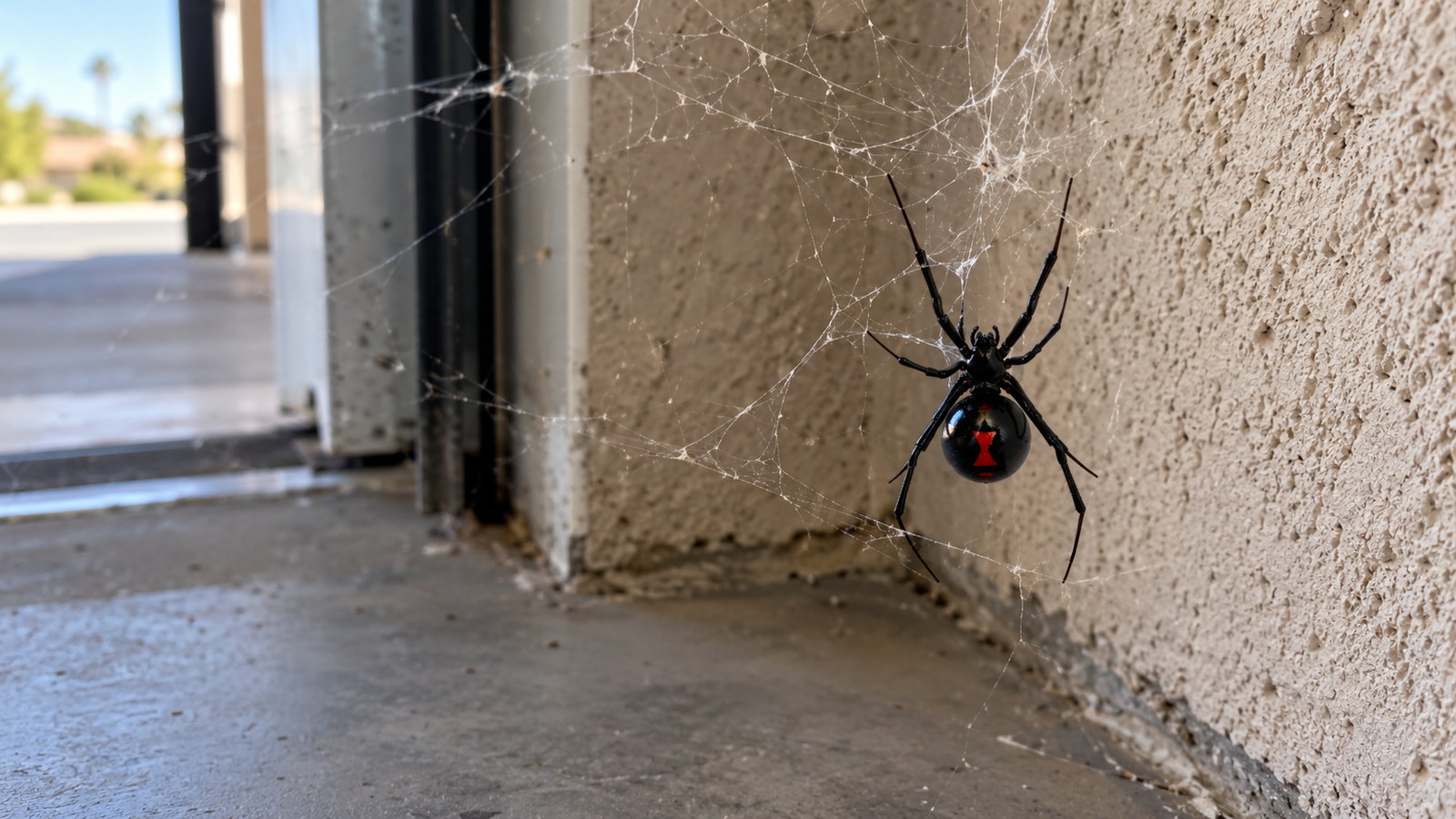
You found a glossy black spider hanging upside down in a messy web in the corner of the garage. Here is how to be sure it is a black widow, where the rest of them are, and why the one you kill is not the problem.
Should I be worried if I find a black widow in my house?
Yes, but not about that one spider. Black widows are shy and rarely bite unless pressed against skin. The problem is what one widow tells you. In our experience it is never just one. If you find a black widow, there are usually several more nearby, and they retreat into wall voids where you cannot reach them.
That is why a widow in the garage is the sighting that matters most. A garage is open to the yard under the door, full of quiet corners, and connected to the wall voids of the house. One in the open web tonight usually means more in the voids that you will never see.
How do I know it is a black widow?
A mature female western black widow is glossy black with a round, bulbous abdomen and a red hourglass on the underside, not on her back. She hangs upside down in a messy, tangled web close to the ground, so the hourglass often faces you. Males are small, lighter in color, and not a concern.
The web is the other giveaway. It is irregular rather than a neat wheel, unusually tough, and built low in a corner, crevice, or box. Egg sacs are tan to yellowish, teardrop shaped, and tough. The University of Nevada, Reno Extension notes that the western black widow is found throughout the state, with woodpiles, debris, garages, and protected spots around buildings as its typical hiding places. A tan spider with mottled markings, an orange hourglass, and spiky egg sacs is likely a brown widow, a non-native relative that researchers at the University of California, Riverside report has spread across the southern United States since the early 2000s and describe as less dangerous than the black widow.
Where do black widows hide around Las Vegas homes?
Low to the ground, almost always. We find them in garage corners, in irrigation and valve boxes, under flat rocks in the yard, around stairs, and in the low corners around the outside of the house. A widow wants a dark, undisturbed spot with insects walking past, and every one of those places has all three.
The valve box is the classic one. It is dark, slightly damp, full of the crickets and roaches drawn to the moisture, and nobody opens it for months. Flat rocks and stacked pavers hold the same cool, dark gap underneath. Inside a garage, look at the corners behind stored items, along the base of the walls, and around the bottom track of the door.
Which Las Vegas homes get the most black widows?
Homes near construction or new builds, and homes with more moisture: near water lines, drip irrigation, and anywhere that stays damp. Grading and building disturb the spiders and the insects they eat, and damp spots in a desert yard concentrate prey. A new home with a damp corner has both problems at once.
That pattern runs across the Las Vegas Valley, from new phases in Henderson and the southwest valley around Southern Highlands to established Summerlin streets with heavy drip lines. The common thread is not the neighborhood. It is water and disturbance. A leaking valve or a drip line that keeps one corner wet is feeding the insects that feed the widows.
Why doesn't killing the one you see work?
Because the rest are in the wall voids. Homeowners spray or kill the one widow they see and assume it is handled, but there are usually several more nearby that retreated into cracks and voids a spray never reaches. They do not starve out, either. Someone we know trapped a black widow, and it lived almost two months without food.
That is an anecdote, not a statistic, but it matches what we see on properties. A widow sitting in a void can wait out a dry spell, a cold snap, or one treatment, then rebuild her web in the same corner. Add the egg sacs, which are protected from most treatments, and a single contact kill barely changes the population.
How do you get rid of black widows in Las Vegas?
We treat in three steps. First, a contact treatment for the spiders we find. Second, a longer-lasting microencapsulated residual product in the areas where they live and travel, so spiders moving through those spots later are still exposed. Third, a follow-up treatment 30 to 45 days after the first service, timed for the spiderlings.
The follow-up is the part most people skip, and it is the part that works. The first treatment kills the adults, but egg sacs are protected, and the University of California's statewide pest management program describes the black widow egg sac covering as very tough and difficult to rip apart. The spiderlings hatch after the first visit, and a follow-up 30 to 45 days out catches them before they mature and spread into new corners. Black widow treatment is part of our spider control service, along with web and egg sac removal and control of the crickets and roaches they feed on.
What can you do yourself?
Keep garages and irrigation boxes clean and clutter-free, and stay on a regular treatment schedule. Those two habits do more than any spray from the hardware store, because widows need undisturbed corners and a steady supply of insects, and a tidy garage on a treatment schedule gives them neither.
A few more habits that help:
- Wear gloves when you reach into a valve box or move anything that has been sitting outside, and look before you reach.
- Knock down webs with a broom or hose. It forces spiders to spend energy rebuilding and shows you where they are.
- Keep porch and garage lights off when you do not need them. Lights draw the insects that draw the spiders.
What should you do about a bite?
Call Poison Control at 1-800-222-1222, and seek medical care right away for young children, older adults, or anyone with severe symptoms. Then look for the rest of them, because a bite inside the house or garage almost always means widows are established in the voids and corners around it.
When should you call a professional?
If you find black widows in the garage, call right away. There are likely more in the wall voids, and the garage connects to the rest of the house. We inspect the garage, the valve boxes, the rock, and the low exterior corners, treat what we find, and set the 30 to 45 day follow-up.
When you call or text us, you get a plain explanation of what we found and what we recommend before any work starts. We serve the entire Las Vegas Valley, including Henderson, Summerlin, Anthem, and Boulder City, seven days a week. Call or text for a free inspection.