
Roof Rats in Your Las Vegas Attic: Why Traps Alone Fail
Scratching in the attic? A local technician explains why Las Vegas roof rats live in palms and attics, why traps alone fail, and what actually works.
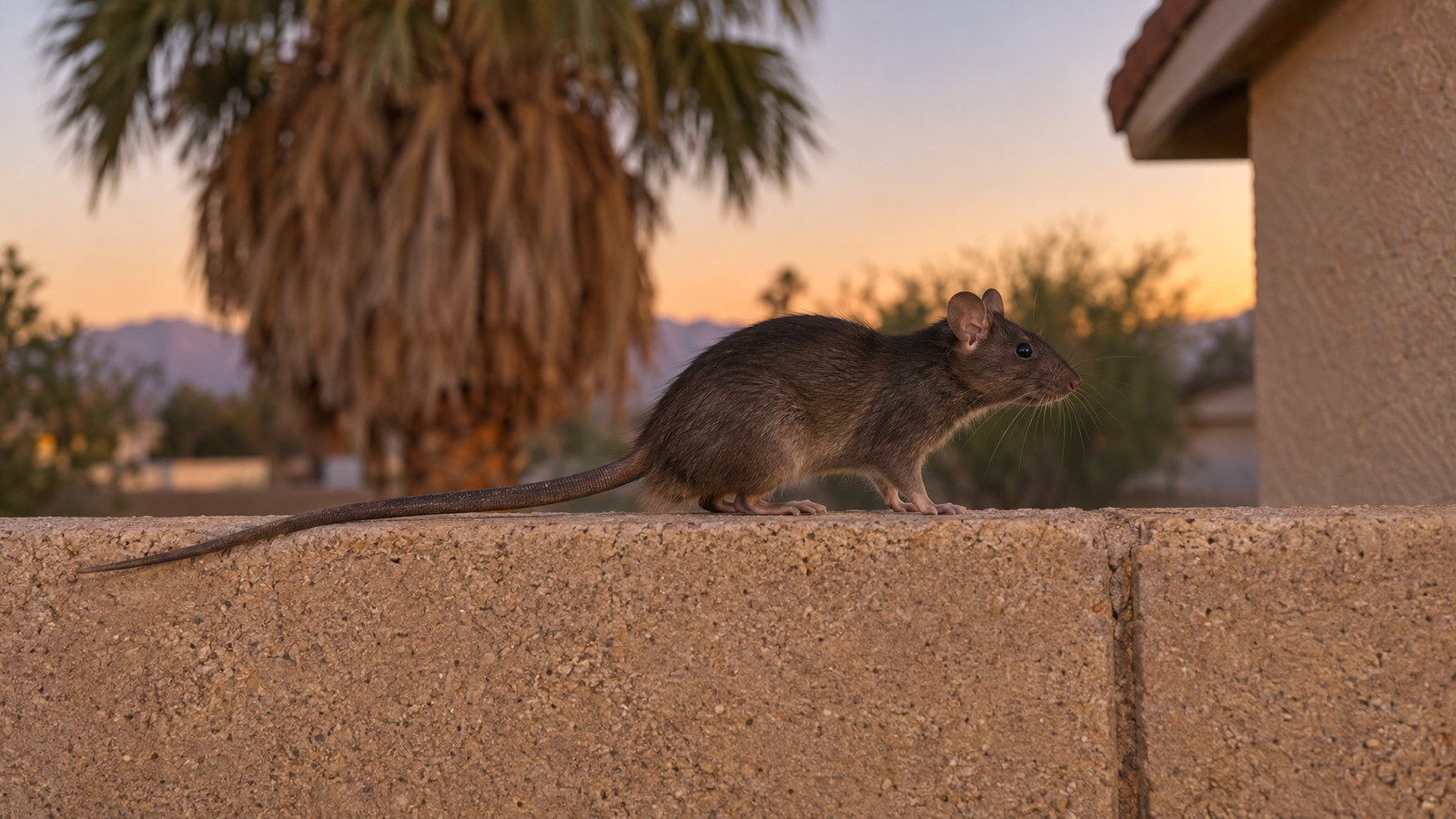
The scratching above the ceiling after dark is the most common way Las Vegas homeowners meet a roof rat. Here is what the animal is, why this valley suits it, why the traps in the garage are not solving it, and what a real program does differently.
Why are there rats in my Las Vegas attic?
Because the rat in your attic is a roof rat, and roof rats live up high. They climb stucco, block walls, utility lines and tree branches, and they nest in palms, fruit trees, garages and attics. We often catch them on camera running along the back wall at night, moving between the trees and the roofline.
The Southern Nevada Health District has documented roof rats in the Las Vegas Valley since 1990, with the first sightings tied to imported palm trees in the central valley. The burrowing Norway rat, the sewer rat of older cities, has been rare here. So a rat problem in this valley is almost always an overhead problem: the skirt of dead fronds on a palm, the fruit tree against the fence, and the attic vent that was never screened.
How do I know it is a roof rat?
A roof rat is slender and dark brown to black, with large ears, a pointed muzzle, and a tail longer than its head and body combined. Adults weigh 5 to 10 ounces and run about 13 to 18 inches long including a tail longer than its body. Droppings are dark, capsule shaped, and about the size of a raisin.
The signs are easy to read once you know them. Hollowed-out citrus still hanging on the tree. Greasy rub marks along a beam or the top of a block wall. Gnawed irrigation lines. And the sound: a roof rat in an attic makes a scurrying, scratching noise that starts after dark and stops at dawn. A house mouse is a third of the size with rice-sized droppings; if you are not sure which you have, the difference changes the approach.
Which Las Vegas neighborhoods have the most roof rats?
The ones with cover and nesting spots. Seven Hills, Summerlin, the ridges of MacDonald Highlands, Southern Highlands, Anthem Country Club, anywhere along the mountains, and anywhere with a golf course. Mature palms, dense landscaping, irrigation and a course or wash nearby give a colony everything it needs within a few hundred feet.
That is why the valley's best-kept neighborhoods have the most rats. The homes along Summerlin that back onto a fairway, the ridge lots in MacDonald Highlands, and the country club streets in Anthem all pair heavy vegetation with water, which the Health District lists as the two conditions roof rat reports cluster around. A bare rock yard in the middle of the valley is a harder place for a rat to live.
Why don't traps alone get rid of roof rats?
Because traps catch some rats, and a colony needs a professional baiting program. A female can raise several litters a year, so a few catches in the garage do not change the count in the palm. Bait stations let many rats feed from one placement, which is how you get ahead of a colony instead of chasing it.
Rats are also smart. They learn to recognize boxes and traps, and a trap that caught two rats in week one is often avoided by week three. That is why we regularly rotate trap types, placements and methods instead of leaving the same device in the same corner. Traps still have a place, especially off the ground on ledges and beams where roof rats travel, but they are one tool in a program, not the program.
How do you get rid of roof rats in Las Vegas?
Our rodent program has four parts. Locked, tamper-resistant bait stations placed along the routes rats use, with professional bait applied according to the label. Monitoring boards to track activity. Trail cameras to see exactly where the rats travel at night. And when they are getting inside, finding and sealing the entry points.
The cameras change the job. Instead of guessing, we see which wall they run, which tree they come down, and which corner of the roofline they use, and the stations go where the traffic is. The monitoring boards tell us at each visit whether feeding is dropping off. Sealing is described plainly: gaps larger than a quarter inch around vents, eaves and utility lines get closed with materials rats cannot chew through. Roof rat work is part of our rodent control service, and every bait placement stays inside a locked station.
What can you do yourself that actually helps?
Take away water and food. Cover pools and other water sources at night, do not leave food or pet food out after dark, and pick up fallen fruit or remove fruit trees that keep feeding the colony. In a desert, a yard with free water and fruit is a destination for every rat within range.
A few more things that matter here:
- Trim palms and remove the skirt of dead fronds. A skirted palm is the single best rat nest in the valley.
- Cut branches back from the roof so there is no bridge from tree to attic.
- Keep bird seed, chicken feed and compost sealed.
- Store garage items in sealed bins off the floor so you can see what is moving.
When should you call a professional?
If rats are inside the house or attic, call. An animal inside means there is an opening somewhere, and it needs to be found and sealed. A rat you hear in the ceiling is not passing through. It is living there, and the noise usually means the colony outside has already outgrown its tree.
When you call or text us, we inspect the attic, the roofline, the palms and fruit trees, and the block walls, explain what we found, and set up the stations, boards and cameras the same visit. We serve the entire Las Vegas Valley, including Henderson, Summerlin, Anthem, Southern Highlands and Boulder City, seven days a week. Call or text for a free inspection.