
Scorpions in Your Las Vegas House: Why They Get In and What to Do
Found a scorpion in your Las Vegas house? A local technician explains why bark scorpions get in, where they hide, why sprays fail, and what works.
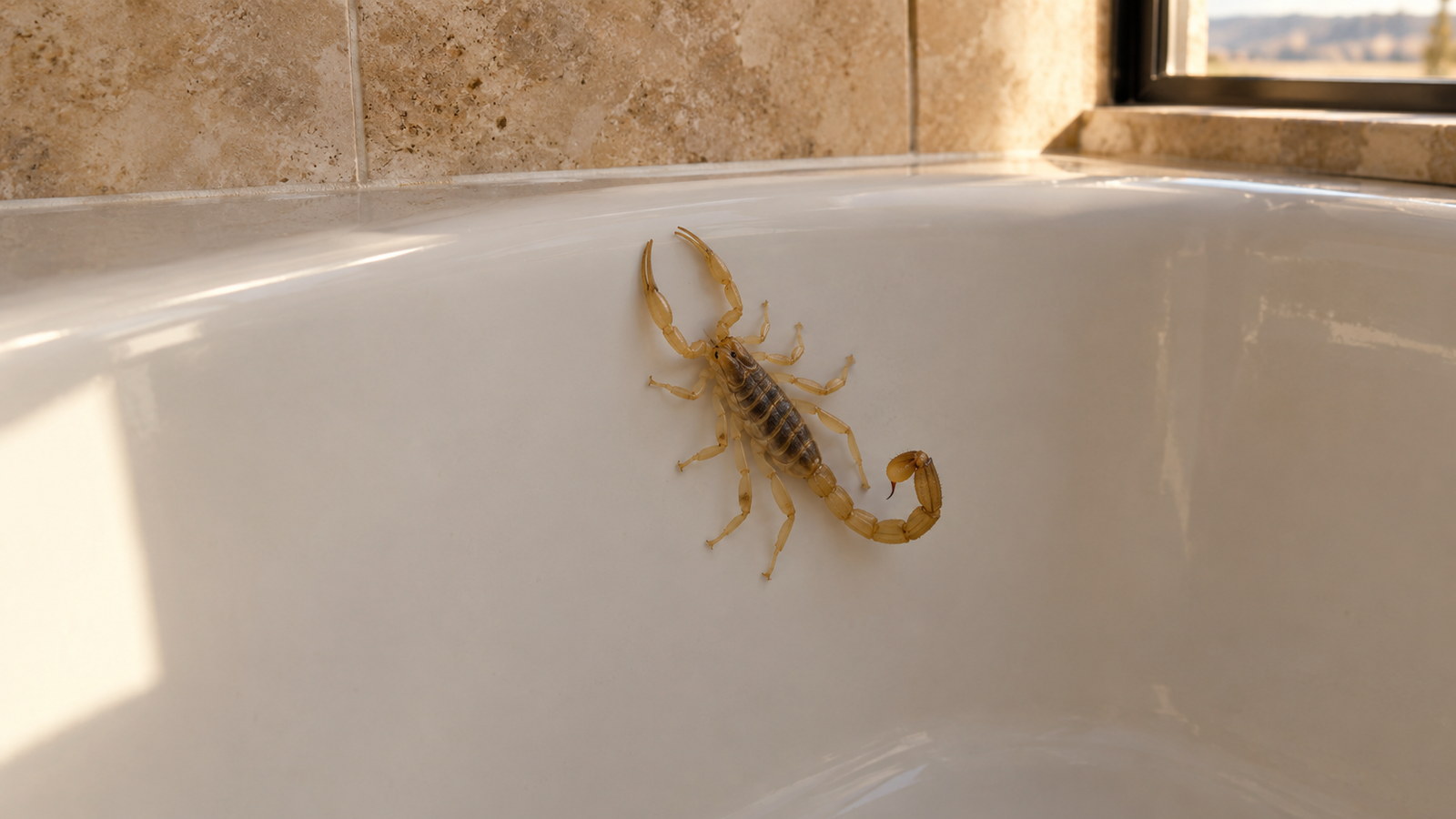
You found a scorpion in the bathtub, in the garage, or next to the shoes on the floor. Here is what that means in the Las Vegas Valley, what we find when we inspect a home like yours, and what actually brings the numbers down.
Why am I finding scorpions in my Las Vegas house?
Scorpions come inside for the same reasons they live in your yard: shelter from the heat, moisture, and insects to eat. The Arizona bark scorpion climbs stucco and block walls, so it reaches door frames, window frames, vents, and roof lines, and it needs a gap only about the thickness of a credit card to get in.
Every neighborhood in the valley was built on top of scorpion habitat, and block walls, rock landscaping, drip irrigation, and palm trees gave scorpions better shelter than open desert ever did. Most of the ones we find indoors came in at night hunting the crickets and roaches drawn to lights and moisture. They can turn up climbing bathtub walls, and once in the tub they often can't get back out.
What kind of scorpion is in my house?
Almost always an Arizona bark scorpion: pale tan to yellow, slender, under three inches long, with thin pincers and a slim tail it often carries curled to the side. It is the only scorpion in the Las Vegas Valley whose sting is considered medically significant, and the only common one that climbs walls.
If it is big and dark, four inches or more, it is probably a desert hairy scorpion, which stays on the ground and rarely gets inside. The National Park Service notes that bark scorpions are nocturnal, glow under ultraviolet light, and spend the winter in groups, which matches what we see in block walls here.
Where do scorpions hide around Las Vegas homes?
Outside, we find them most often in garages, in irrigation and valve boxes, around pools and pool equipment, in overgrown or untrimmed palm trees, including young palms, and around plant roots. Inside, they turn up in shoes, in clothing left on the floor, and climbing the walls of bathtubs.
Every one of those spots is dark, tight, and close to water or insects. A garage has the biggest gap in the house, the bottom seal of the roll-up door. The hollow cells inside block walls, the weep holes at the base, and the gaps where a wall meets the stucco are exactly the kind of voids a dust treatment is made for.
Which Las Vegas neighborhoods have the most scorpions?
Neighborhoods built against open desert and neighborhoods next to new construction, and the worst cases are homes with both. The ridge homes in MacDonald Highlands on the edge of Henderson, Inspirada, Mountain's Edge, and any home that backs onto open desert see far more scorpions than streets deep inside the valley.
The desert edge supplies scorpions every season, and grading for new homes pushes the ones already living in the ground into the finished houses next door. The same pattern holds wherever the valley meets open ground, from Anthem on the foothills to the Summerlin villages closest to Red Rock.
When is scorpion season in Las Vegas?
Scorpions are active from about March through October, with the most sightings on hot nights from June through September. Monsoon season, when humidity and insect activity rise in late summer, is usually the busiest stretch. In winter they slow down and gather in groups inside walls and other voids, so spring brings them back out.
The quiet you notice in December is not an empty wall. It is a full one waiting for warm nights, which is why spring is the time to deal with them, not the week after the first sting.
Does one scorpion in the house mean there are more?
Usually, yes. Bark scorpions share harborage, and the one you saw is the one that got stranded. In our experience there can be several, sometimes five to ten, hiding in the wall voids of a home where the owner has only ever seen one. One inside is the point to get the property inspected.
An hour after dark on a warm night, walk the block walls and the base of the house with a UV flashlight. Scorpions glow blue-green and are easy to spot. One or two on a back wall is normal here. Several on the house itself, or any in the garage, means they are using your home as shelter.
Why doesn't spraying get rid of scorpions?
Scorpions have a tough, waxy outer layer, and liquid sprays dry fast on hot stucco and block, so a spray alone rarely does much. Dusts work far better. The particles cling to the scorpion as it moves through a treated crack or void, and they stay put in dry, protected spaces for a long time.
This is the mistake we see most. Unless a spray lands on the scorpion itself, it dries into a film the scorpion walks over. Two dusts do the real work. Diatomaceous earth is a mineral dust, made of fossilized algae, that scratches and dries out the outer layer. Deltamethrin dust is a professional insecticide dust that stays active inside the voids where scorpions rest during the day.
How do you get rid of scorpions in Las Vegas?
We treat where scorpions live, not where you saw one. That means a targeted dust treatment in the voids, cracks, and harborage areas where they hide, a preventive barrier around the exterior of the home to keep roaming scorpions from getting in, and, in some cases, a night visit with a UV black light to find and treat them directly.
Here is how that works on a typical Henderson or Las Vegas lot:
- Dust the harborage. Insecticide dust goes into the voids and cracks where they hide: block wall cells and weep holes, the gaps where walls meet the house, around valve boxes and pool equipment, and the voids around the garage. This is the part that reaches the scorpions you never see.
- Barrier the exterior. A pyrethroid product goes around the outside of the home to stop roaming scorpions before they reach a door or a wall gap. Pyrethroids are a synthetic class of insecticide modeled on compounds found in chrysanthemum flowers.
- Hunt them at night when needed. In some cases we come back after dark with a UV black light. Scorpions glow under UV, so we can find them on the walls and treat them directly instead of guessing.
Scorpion treatment is part of our scorpion control service, and controlling the crickets and roaches they feed on is part of the same visit. The goal is control and steady reduction, not a promise that you will never see another one.
What can you do yourself that actually helps?
Keep shoes and clothes off the floor and shake out shoes before you put them on. Keep palm trees trimmed and maintained, or remove a palm that keeps producing scorpions. Seal the gaps and cracks in block walls. Diatomaceous earth around the property can help somewhat, but it is not a fix on its own.
Two more habits that matter here:
- Fit tight sweeps on exterior doors and a fresh bottom seal on the garage door. If you can see daylight, a scorpion can get through.
- Walk the yard with a UV flashlight a few nights a month so you know whether the numbers are going down.
What should you do if you get stung?
A bark scorpion sting is very painful. Call Poison Control at 1-800-222-1222, and seek medical care right away for young children, older adults, or anyone with severe symptoms. Then deal with the cause. A sting inside the house almost always means scorpions are living in the walls or landscaping around it.
When should you call a professional?
If you find even one scorpion inside, call. There are likely more nearby, and the ones in the wall voids are the ones you never see. One of our customers was stung, decided not to use a professional service, and was stung by a bark scorpion again a week later.
When you call or text us, we walk the whole property, inside and out, including the block walls, landscaping, and garage, and explain in plain language what we found and what we recommend before any work starts. We serve the entire Las Vegas Valley, including Henderson, Summerlin, Anthem, and Boulder City, seven days a week. Call or text for a free inspection.