
Mice in Your Las Vegas House: How to Tell Mice From Rats and What to Do
Droppings in the garage or a mouse in the pantry? A local technician explains how to tell mice from roof rats, how they get in, and what gets rid of them.
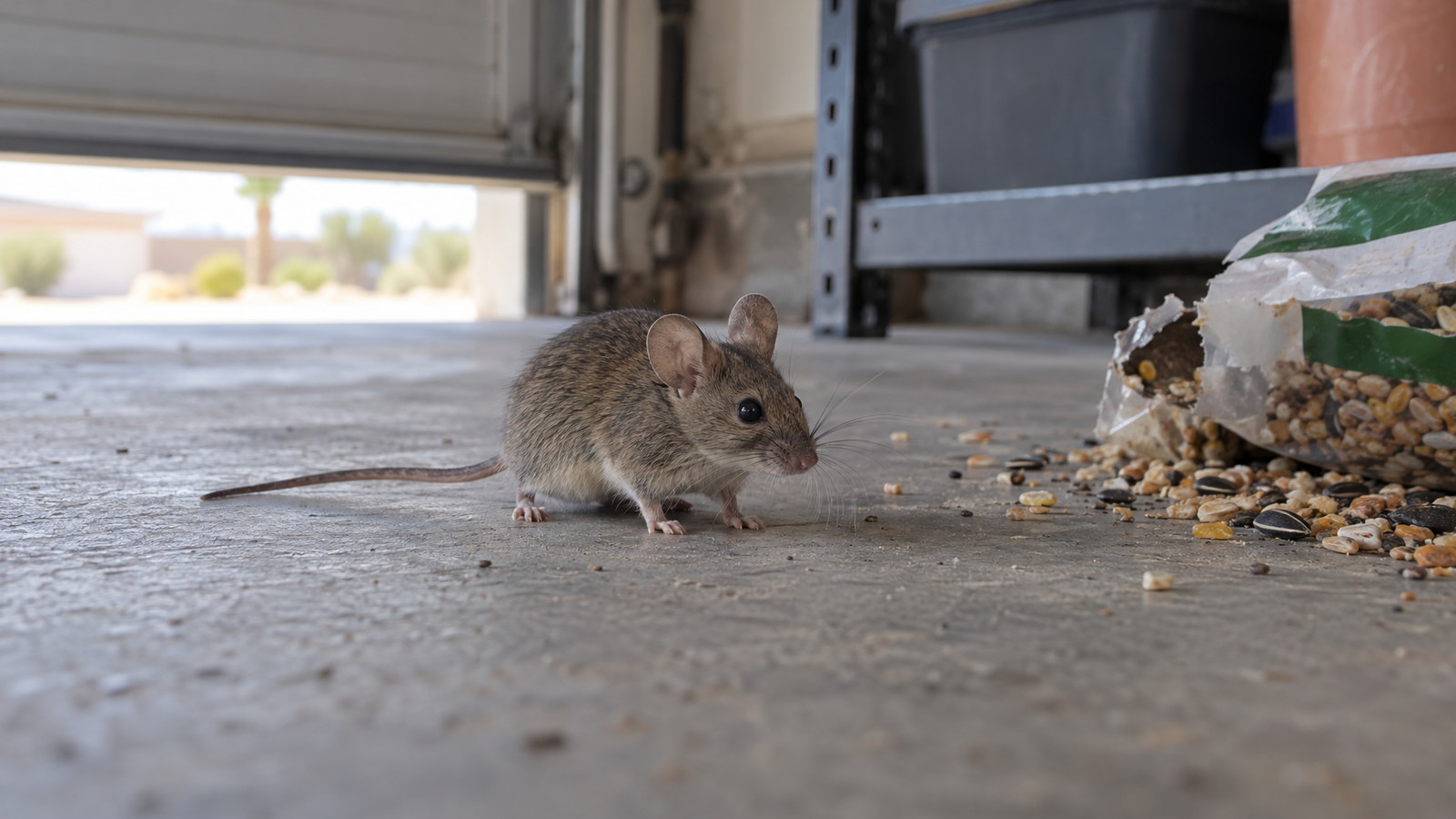
Rice-sized droppings in the garage, a chewed corner on a bag of dog food, a flash of gray along the baseboard at night. Before you buy a trap, it helps to know whether you have mice or rats, because the two problems are handled differently in this valley.
Is it a mouse or a rat?
Size settles it. A house mouse is small and gray-brown, 5 to 7 inches long including the tail, with large ears and a thin, nearly hairless tail. A roof rat is two to three times that size with a tail longer than its body. Mouse droppings are rice sized; rat droppings are raisin sized.
Where you find the signs matters as much as the size. Mice work low: garages, pantries, the drawer under the oven, the back of a closet, and the wall voids behind them. Roof rats work high, in attics, palms, fruit trees and along the roofline, and we wrote a separate guide to roof rats in Las Vegas attics. If the noise is above your ceiling, start there. If the droppings are in the garage or kitchen, keep reading.
How do mice get into a Las Vegas house?
Through gaps you would never notice. The University of California's pest management program notes that a house mouse can enter through an opening as small as a quarter inch, about the width of a pencil. Here that means a worn garage door seal, the gap around an AC line or hose bib, and the space under an exterior door.
Mice are also excellent climbers, so a shrub against the house or a stacked woodpile is a ladder to a vent. Once inside, they nest in sheltered spots with soft material, which is why a garage shelf of boxes, an unused drawer, or the insulation inside a wall void turns up a nest of finely shredded paper. The garage is where most Las Vegas mouse problems start, because it has the biggest gap and the most stored food.
Where do mice hide around Las Vegas homes?
The same places roof rats use, plus fields, golf courses and wall voids. Outside, that means dense landscaping, palms, fruit trees, garages and the block walls that connect them. Inside, mice favor the garage, the pantry, the voids behind kitchen cabinets, and any wall that carries plumbing or wiring from the garage into the house.
Wall voids are the mouse's advantage. Mice move through them easily, which is how droppings show up far from where they got in, such as a second-floor bathroom when the entry point is the garage. Homes in Henderson and the southwest valley around Southern Highlands that border a golf course or open field, and the lush, watered lots around Lake Las Vegas, see mice year round because the population outside never runs out.
Why are mice easier to deal with than rats?
Mice are somewhat easier to trap and bait. Smaller traps and smaller locked bait stations work well, because a mouse is curious, ranges only a short distance from its nest, and does not learn to avoid a device the way a rat colony does. Rats need a more comprehensive approach with cameras, monitoring and rotation.
Easier does not mean a single trap in the garage fixes it. A female can raise five to ten litters a year, and a mouse family in a wall void keeps sending explorers out. The difference is that a well-placed set of traps and small stations along the walls, checked and adjusted, brings a mouse problem down quickly, while the same effort against a rat colony usually does not.
How do you get rid of mice in Las Vegas?
We place snap traps and small locked, tamper-resistant bait stations along the walls and runways where droppings show activity, with professional bait used according to the label and never loose. Monitoring boards tell us whether the activity is dropping. When mice are getting inside, we find the gap they use and seal it.
Placement is the whole skill. Mice run along edges, so devices go tight to the wall, behind stored items, and in the dark corners of the garage, not in the middle of the floor. Entry points are described plainly: gaps larger than a quarter inch around the garage door, doors, pipes and vents get closed with materials mice cannot chew through. Mouse work is part of our rodent control service, and the sealing is what keeps the next family out.
What can you do yourself that actually helps?
Cover pools and other water sources, do not leave food or pet food out at night, and pick up fallen fruit or remove fruit trees that keep feeding them. In the garage, move birdseed, dog food and grass seed into sealed bins. A bag of seed on the floor feeds a mouse family for a season.
Then shut the door on them:
- Replace the garage door's bottom seal if you can see daylight under it, and add sweeps to exterior doors.
- Seal around pipes, cables and vents where they enter the house.
- Store garage items in sealed bins off the floor and keep the clutter down so you can see activity.
- Trim shrubs and remove woodpiles against the house.
When should you call a professional?
If mice are inside the house or garage, call. There is an opening somewhere, and it needs to be found and sealed, or you will trap the same family over and over. Droppings in the pantry or a nest in a drawer mean they are established, not passing through.
When you call or text us, we inspect the garage, the kitchen, the wall voids and the outside of the home, show you the entry point, and set the traps and stations the same visit. We serve the entire Las Vegas Valley, including Henderson, Summerlin, Southern Highlands, Lake Las Vegas and Boulder City, seven days a week. Call or text for a free inspection.
Related
More guides
Roof Rats in Your Las Vegas Attic: Why Traps Alone Fail
Scratching in the attic? A local technician explains why Las Vegas roof rats live in palms and attics, why traps alone fail, and what actually works.
Black Widows in Your Las Vegas House: Why There Is Never Just One
Found a black widow in your Las Vegas garage? A local technician explains where they hide, why killing the one you see fails, and how treatment works.
German Cockroaches in Your Las Vegas Kitchen: Why One Is an Emergency
Small striped roach under the sink? A local technician explains why one German cockroach in a Las Vegas kitchen is urgent and what treatment involves.